

Package & Jolt Testing – Simulating Transportation Conditions to Assess Package Performance OR Transit Test
VIBRANT Vibration Package Testing Machines are designed to scientifically replicate the vibrations and jolts experienced by filled containers during transportation. Based on the guidelines provided by ASTM D-999, TAPPI T-S17-pm, and IS7028 (Part II), these machines allow for controlled testing under standard laboratory conditions to assess the durability and performance of packaging systems.
Advantages
- Offers close simulation of transportation conditions in a laboratory environment.
- Provides insights into packaging performance, facilitating improvements in design for enhanced strength and protection.
- Enables prediction of package behavior in distribution systems, saving costs and reducing risks associated with damaged goods.
Applications of Vibration Package and Jolt Testing Machines
- Transportation Impact Simulation
Simulates the conditions experienced during transportation by road, rail, sea, and air, or in combination of modes, helping manufacturers understand how their packages perform under real-world conditions. - Package Strength and Protection Assessment
- Evaluates the ability of containers to provide physical protection for contents during transit.
- Helps identify potential weaknesses in packaging systems subjected to varying intensities of vibrations.
Machine Details and Features
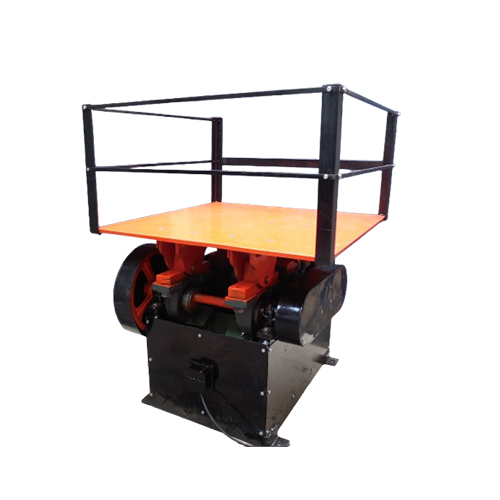
- Rigid Fabrication – Constructed from mild steel (MS) material for structural integrity.
- Suspended Table Top – Equipped with bearing blocks for vibration suspension.
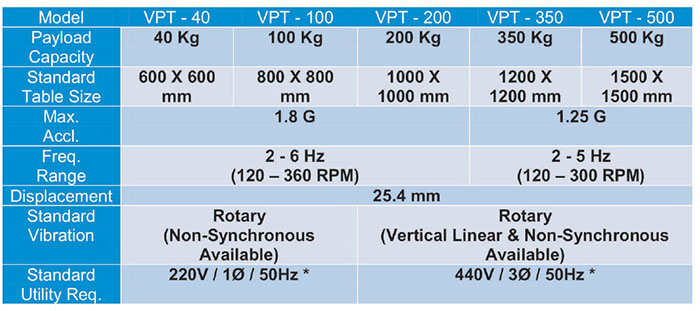
- Fixed Amplitude – Provides 4 mm amplitude via cam assembly.
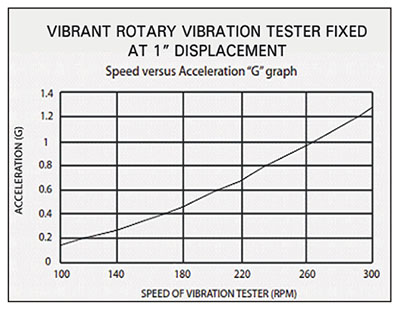
- Adjustable Frequency – Frequency range adjustable between 2 Hz to 6 (8) Hz using a panel box for precise testing conditions.
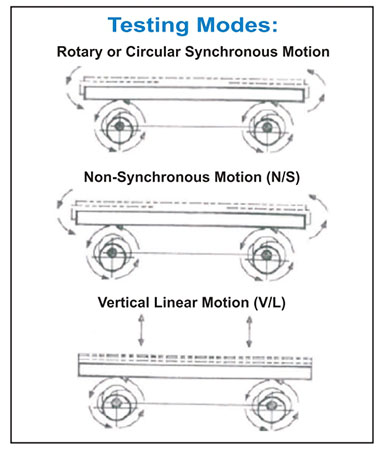
- Multiple Vibration Modes – Allows for three types of vibration:
- In-Phase Vibrations – Both cam assemblies are synchronized, moving the tabletop ends simultaneously.
- 90° Out-of-Phase Vibrations – One end of the tabletop moves 90° out of phase with respect to the other.
- 180° Out-of-Phase Vibrations – The cam assemblies are completely out of phase, creating opposite movement between the two sides of the tabletop.